
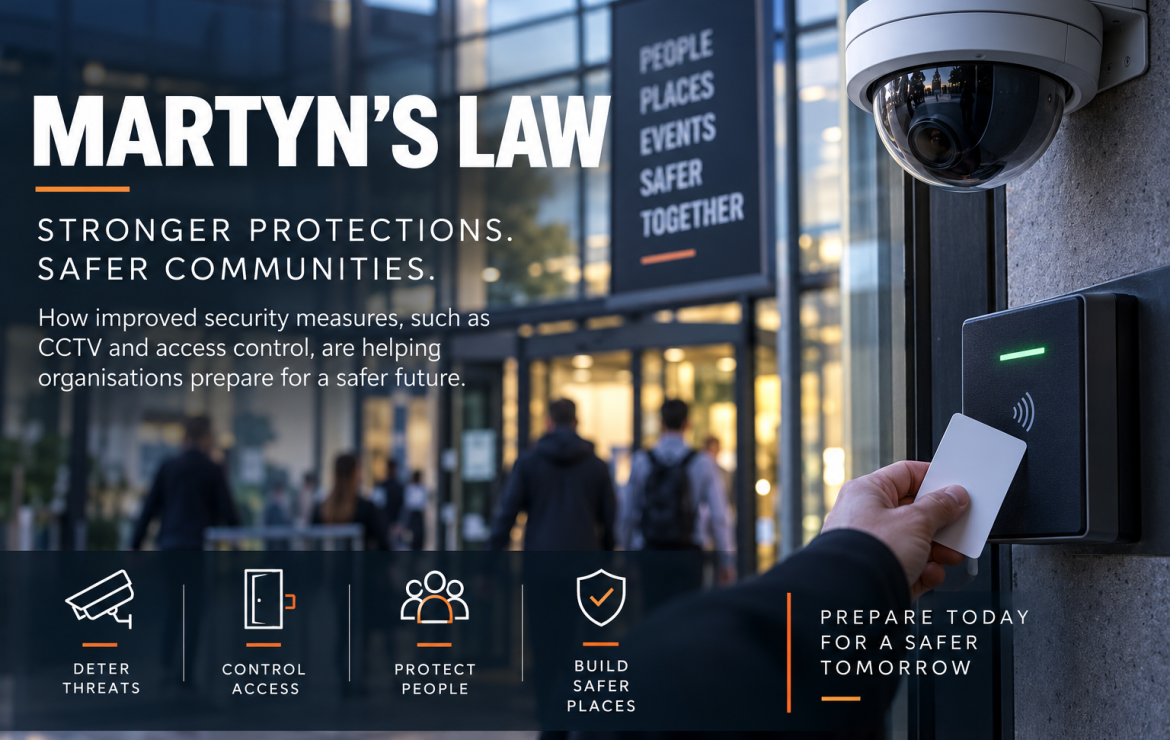
Martyn’s Law: What UK Businesses Need to Know Before It Comes Into Force
The UK’s most significant venue-security legislation in decades is on its way, and businesses that manage public-facing premises have a narrowing window to prepare.
What is Martyn’s Law?
The Terrorism (Protection of Premises) Act 2025, widely known as Martyn’s Law, received Royal Assent on 3 April 2025.
It is named in memory of Martyn Hett, one of 22 people killed in the 2017 Manchester Arena attack, and introduces the first statutory duty on premises and event operators to prepare for, and respond to, the threat of terrorism.
The Act follows a minimum 24-month implementation period, with commencement widely expected in Spring 2027. The Home Office published its statutory guidance under Section 27 in April 2026, and the Security Industry Authority (SIA) which is confirmed as the regulator, has been consulting on how it will exercise its enforcement powers.
Read More here : https://homeofficemedia.blog.gov.uk/2025/04/03/martyns-law-factsheet/
Who does it affect?
Martyn’s Law introduces a two-tier system based on expected occupancy, including staff:
- Standard Tier (venues expecting 100–799 people): straightforward, low-cost procedures covering staff training, evacuation and lockdown planning, and basic public protection measures.
- Enhanced Tier (venues expecting 800+ people): a more comprehensive duty, requiring documented risk assessments, formal public protection procedures, and evidence of physical security measures such as CCTV, access control and monitoring — provided to the SIA on request.
Tens of thousands of premises across retail, hospitality, education, entertainment and public sector venues are expected to fall within scope.
Why it matters now
There is no legal obligation to comply until the Act formally commences. However with statutory guidance now published and the enforcement framework taking shape, organisations that wait until commencement to start planning will be working against the clock. Standard Tier non-compliance can carry penalties of up to £10,000; Enhanced Tier non-compliance can reach the greater of £18 million or 5% of global revenue, alongside compliance and restriction notices.
The practical preparation window is now: understanding which tier a premises falls into, reviewing existing security infrastructure, and closing any gaps well ahead of Spring 2027.
How CIVION can help
Security is already at the core of what we do. As a Midlands-based, multi-disciplinary contractor delivering integrated security systems, CCTV and access control alongside our electrical and construction services, CIVION is well placed to help clients assess their current provision against Martyn’s Law requirements and to design, install and maintain the physical security measures that underpin compliance, whatever tier your premises falls into.